



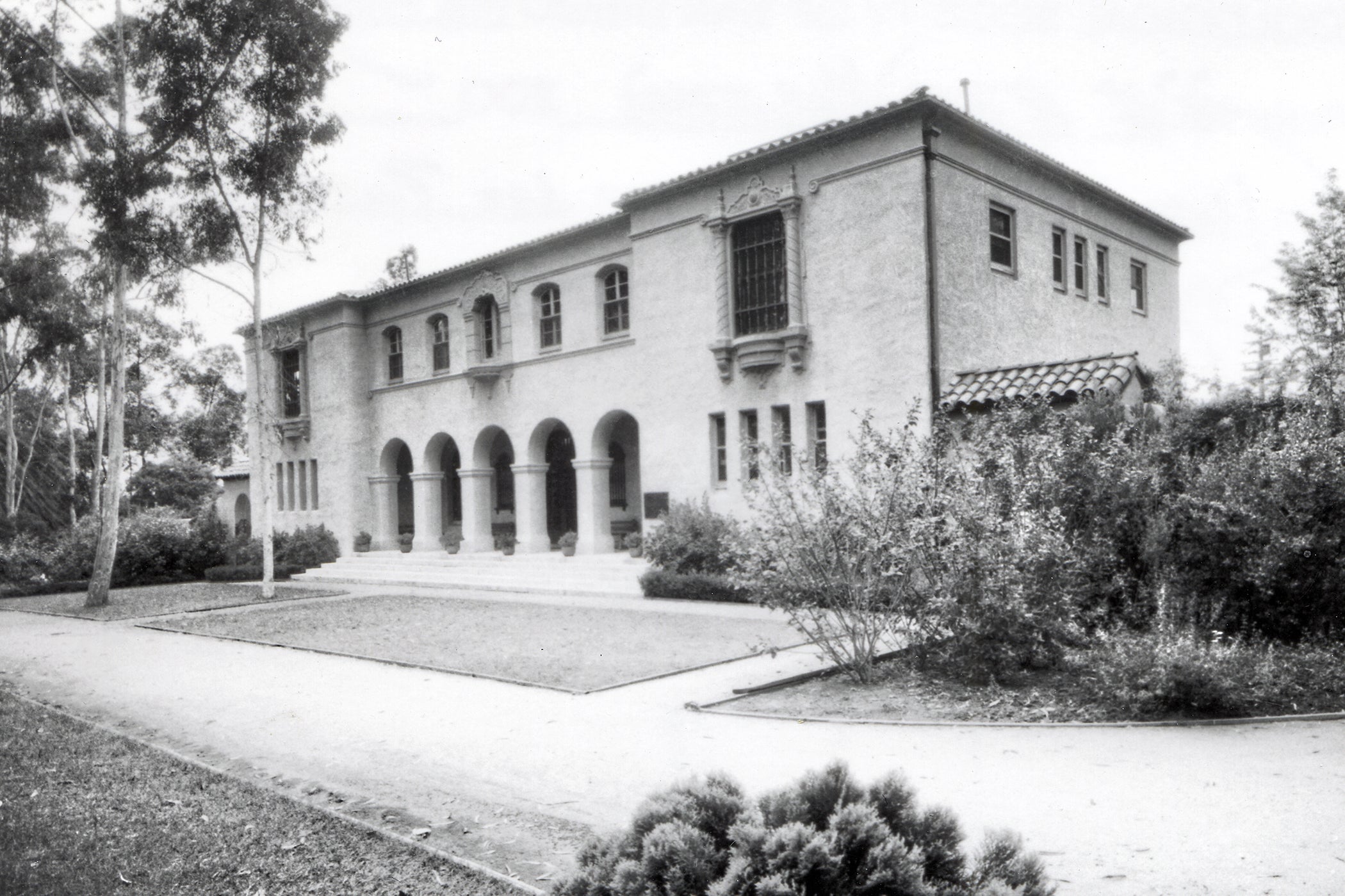
The San Diego Zoo’s first hospital opened in 1927, just over a decade after the Zoo itself was established in Balboa Park. At the time, medical practices were limited to the tools and knowledge available for people and domestic animals, and most treatments were reactive—responding to illness or injury as it occurred. Composed of Dr. Harry Wegeforth and his colleagues that were MDs, the early medical teams were not veterinarians. They did their best with what they had, often adapting procedures from humans, livestock, or companion animal care for use with exotic species.
In 1927, the Ellen Browning Scripps Zoological Hospital and Biological Research Institute opened. The Zoo’s first full-time veterinarian and research director was Dr. R. A. Whiting, a graduate of Cornell University and associate professor of pathology at Purdue University. In the 1930s, Dr. Charles Schroeder, a graduate of Washington State University, was hired as a full-time veterinarian and pathologist. Dr. Schroeder later became Zoo director from 1954 to 1972.
As the Zoo grew and the need for specialized care increased, veterinary medicine began to develop into a true science of zoological medicine. This transformation accelerated in the late 20th century, driven by improvements in anesthesia, imaging technology, and surgical techniques, as well as a better understanding of species-specific physiology and behavior. In 1977, the Jennings Center for Zoological Medicine opened at a cost of approximately $1 million. This facility allowed for a greater level of care for wildlife that needed hospitalization, preventive medicine, nutrition services, and comparative biology and pathology. In the early 1990s, Ph.D. student Mark Edwards came to the Zoo to study GI transit times in lemurs. Once he obtained his Ph.D., he was hired as the zoo’s first full-time nutritionist in 1994 and San Diego developed one of the first clinical nutrition programs when most other nutrition programs were research oriented.
A major Alliance milestone came in 2001 with the opening of the Paul Harter Veterinary Medical Center at the San Diego Zoo Safari Park. This state-of-the-art facility was designed specifically for the medical care of wildlife species, especially the variety of hoofed animals that resides at the Park. With dedicated surgical suites, diagnostic imaging, laboratory space, and areas for both small and large species, the Harter hospital elevated the standard of care dramatically. It also provided greater opportunities for research, collaboration, and training, reinforcing the Alliance’s role as a global leader in wildlife health.
Today, veterinary care at both the San Diego Zoo and Safari Park is proactive, comprehensive, and rooted in a philosophy of preventative medicine. Rather than waiting for wildlife to show signs of illness, the veterinary teams focus on regular health monitoring, nutrition, enrichment, and early diagnostics to detect and address potential issues. Preventative care includes everything from dental cleanings and routine blood work to vaccine protocols and behavioral conditioning that allows for voluntary participation in health checks.
Modern tools have transformed what’s possible. Computed tomography (CT) scans now allow for detailed internal imaging of everything from a lion’s skull to a tortoise’s shell, enabling veterinarians to diagnose internal conditions with remarkable accuracy. Minimally invasive procedures, such as endoscopy and laparoscopy, are used to perform surgeries or obtain biopsies with less pain and faster recovery times—crucial advantages when treating endangered species.
Looking ahead, the future of veterinary medicine at the San Diego Zoo will be just as exciting. Decades of innovation, along with the ever-growing understanding of the role veterinary care plays in wildlife conservation, are the perfect prescription for a healthy tomorrow.