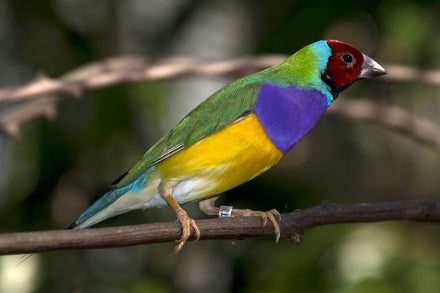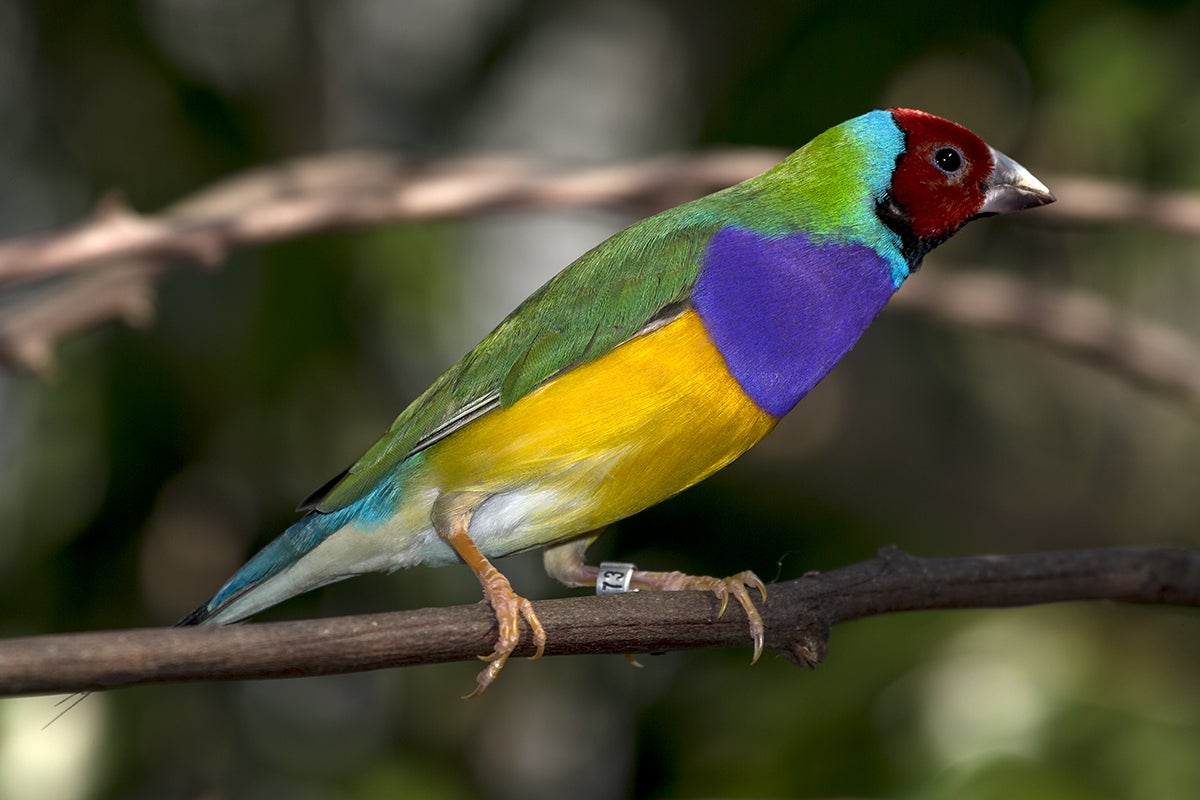
The stunning Gouldian finch is a feathered kaleidoscope that comes in three distinct color variations, with individuals having a red, black, or yellow head.

A flash of fuchsia against moss-green leaves. A pop of periwinkle outlined by pine. Thanks to the palette of plumage that awaits, every season can be merry and bright at the San Diego Zoo and San Diego Zoo Safari Park. From peachy pinks and ruby reds to turquoise and teal greens, there is a virtual rainbow of shades to find throughout dynamic aviaries and habitats.
Spotting the Tones at the Zoo
The pompadour cotinga is native to the Amazon rainforest, where its distinctive song drifts through the canopy. It is considered one of the most stunning birds in the region, and males pack a lot of beauty into their seven-inch-long bodies. Their deep, metallic burgundy-red body feathers are set off by bright white wings with black tips. As with many bird species, female pompadour cotingas are more subtly colored. Their gray plumage and lighter bellies provide camouflage, which helps protect them while they sit on a nest. Behold these beauties in the William E. Cole Family Hummingbird Habitat at the Zoo.
Parker Aviary is the place to experience the vibrant keel-billed toucan. Native to rainforests ranging from southern Mexico to northern Colombia and northwestern Venezuela, the keel-billed toucan is adorned with shiny black feathers, contrasted by a bright yellow face, throat, and chest; red feathers under the tail; and blue feet. Its most defining feature, however, is its glorious, multicolored five- to six-inch bill. While it may look heavy, the beak’s hollow keratin structure is surprisingly light.
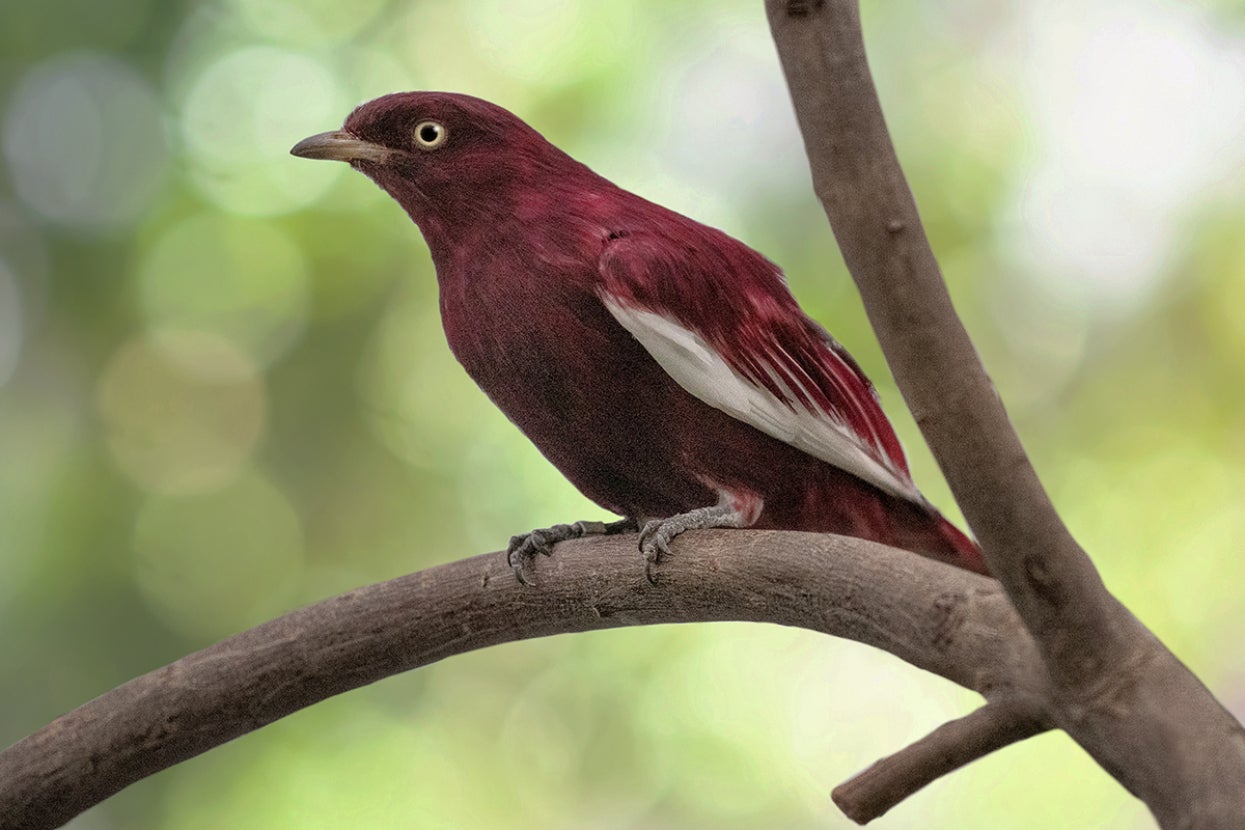
The pompadour cotinga is native to the Amazon rainforest.
How spectacular are emerald starlings? Their metallic-green crown, back, wings, and tail—complemented by rich metallic-purple ear coverts, cheeks, and underparts—are so vibrant that these West African avian wonders are also called iris glossy starlings. Their beauty is more than skin—or feathers—deep. Microscopic layers in the feathers scatter and reflect light, so the birds do not rely solely on pigments for their color. Weighing only about two ounces, the emerald starling is one of the smallest starling species, but it packs a lot of “wow” into that small package. Both sexes deliver, as females are also brightly hued. Catch a glimpse of them in Scripps Aviary and Gorilla Tropics.
One of the most colorful birds in the world, the Gouldian finch (pictured at top) is also commonly called the rainbow finch or simply the Gould. This half-ounce feathered kaleidoscope comes in three distinct color variations, with individuals having a red, black, or yellow head. All have a wide turquoise band across the back of the head, and the nape and sides of the neck are light green. The finch’s back and wings are purplish blue. The lower breast, sides, and abdomen are yellow, fading to white. Both sexes have purple breast feathers: bright in males and a tad more subdued in females. Juveniles are easy to identify by their greenish-gray plumage. Find these truly beautiful colors in the Zoo’s Conrad Prebys Australian Outback.
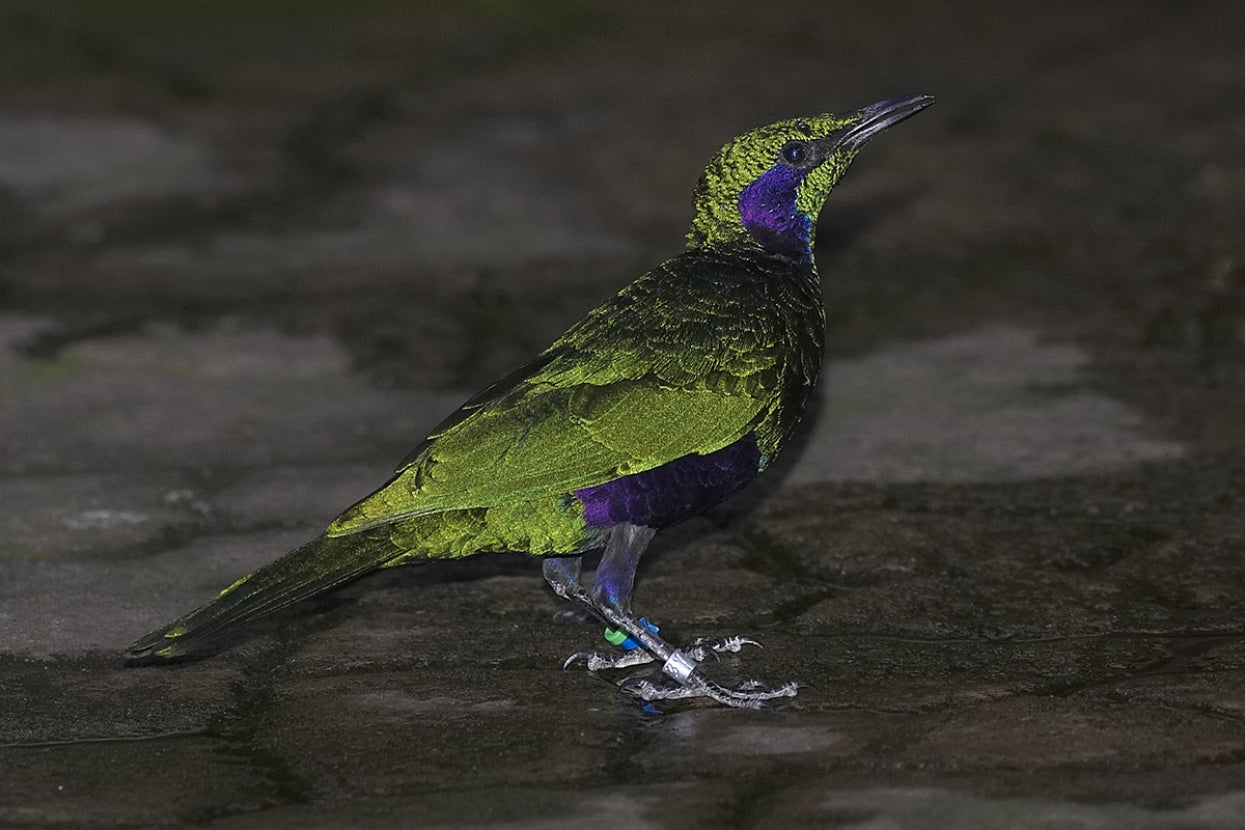
The vibrant emerald starling is one of the smallest starling species.
Scarlet macaws are the poster birds for multicolored avian beauty. Bright red with yellow and blue on its wings, this Central and South American species is one of the largest parrots in the world. It is known for its intelligence and its loyalty to its mate. You can find scarlet macaws in aviaries around the Zoo. They also help guests start their day as part of the opening ceremonies and take part in the daily Wildlife Wonders presentation at Wegeforth Bowl.
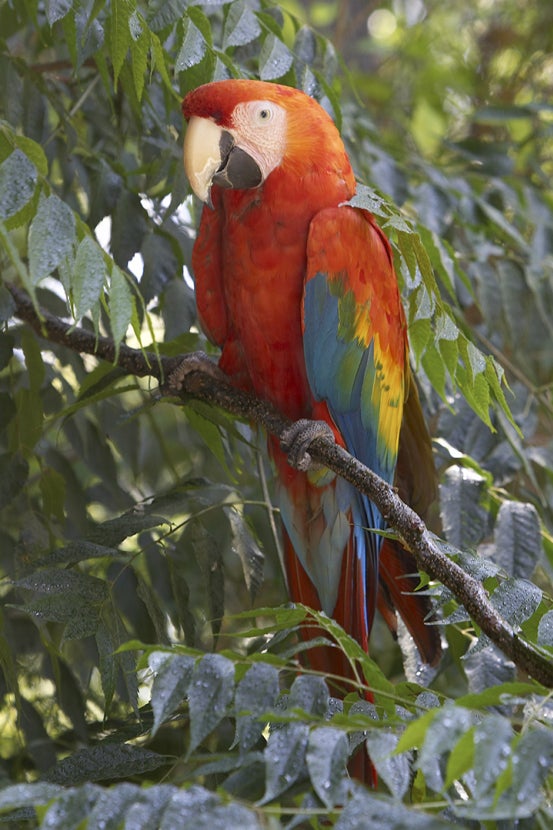
The scarlet macaw is known for its intelligence and its loyalty to its mate.
Flights of Fancy at the Safari Park
Your bird-appreciation tour of the Safari Park begins just inside the main entrance at Wings of the World, a dynamic multispecies bird experience. If the great blue turaco’s mohawk-like crest doesn’t catch your eye, its vivid yellow-and-red beak will. Native to central and western Africa, the great blue turaco is the largest turaco species. Members of the turaco family produce unique copper-based pigments called turacoverdin (green) and turacin (red). For this reason, some consider them the only birds with true green coloration.
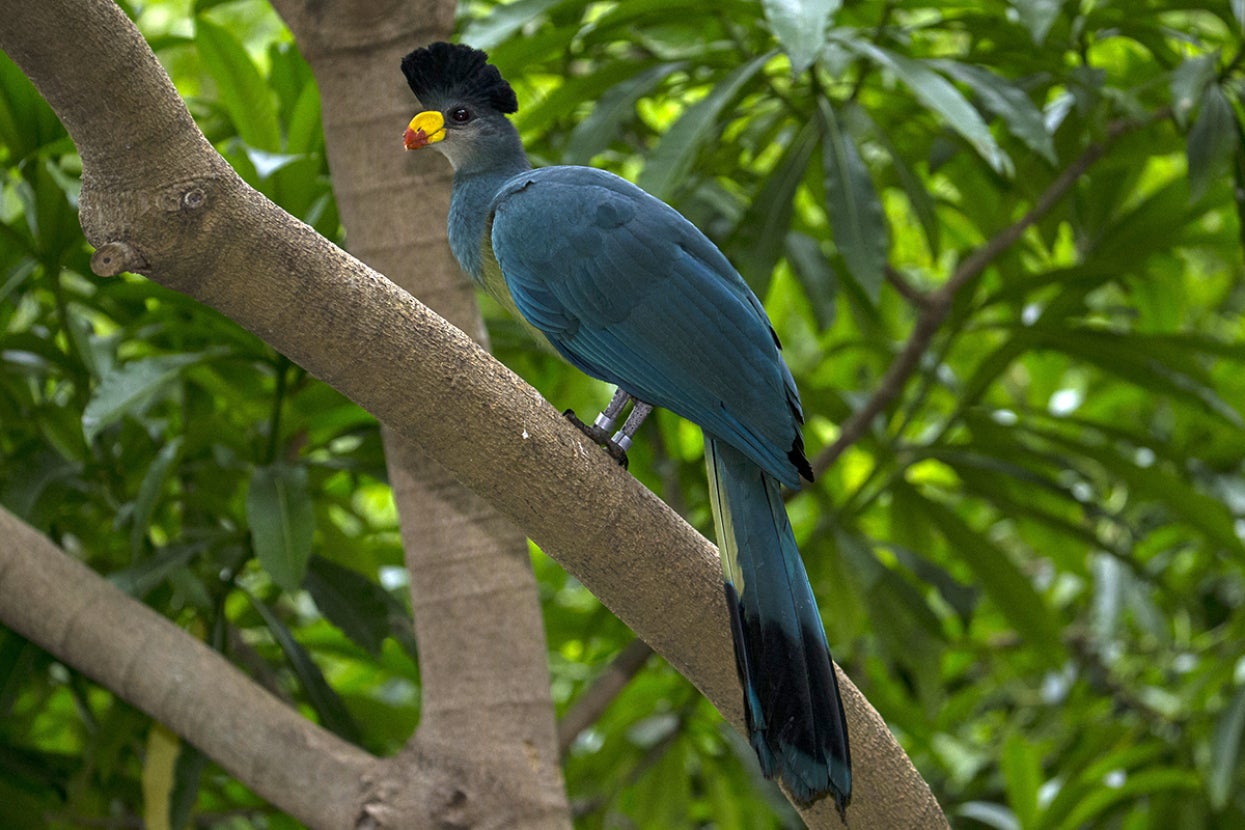
The great blue turaco is the largest turaco species.
Inside the Safari Park’s Hidden Jungle, you might hear the Andean cock-of-the-rock’s raucous call before you spot the male’s intense orange plumage, prominent semicircular crest, and gray-and-black wing feathers. Like their Guianan relatives, male Andean cocks-of-the-rock gather at display sites called leks. There, they perform elaborate courtship dances to impress the females, which are chestnut brown.
Before you leave Hidden Jungle, look for a stunning turquoise-blue bird with black spangling on its wings, tail, and back and a deep wine-red throat. Native to the Amazon rainforest, the spangled cotinga lets its feathers do the talking. This species doesn’t sing, but its wings make a whistling sound in flight.
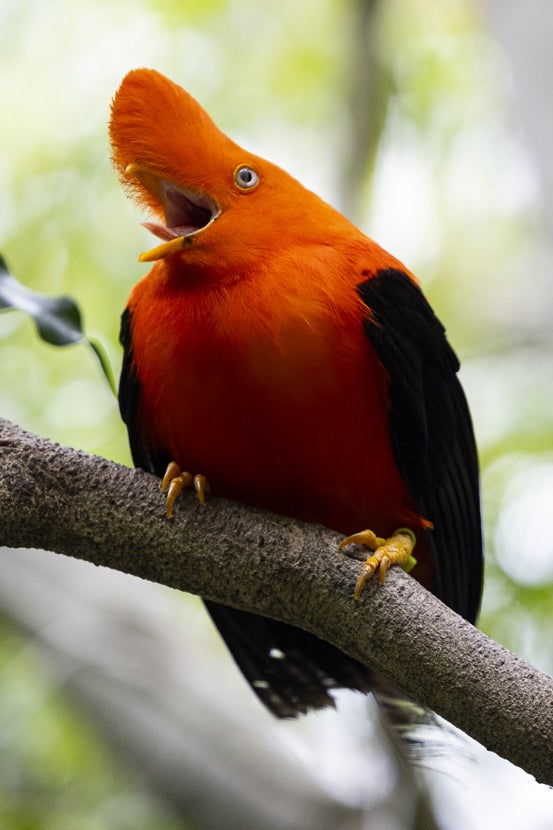
The spectacular orange plumage on male Andean cocks-of-the-rock is a real head-turner.
With plumage that ranges from pink to red, the scarlet ibis is hard to miss inside the Safari Park’s Rainforest Aviary. Like flamingos, scarlet ibises get their color from carotenoid pigments in their food. Native to tropical South America and parts of the Caribbean, these long-legged wading birds use their thin, downward-curved bills to probe for food in mud and shallow water.
Thanks largely to its striking, seven-inch-long yellow-orange beak, the toco toucan is the best-known member of the toucan family. That attention-grabbing bill may look heavy, but as with the keel-billed toucan, appearances can be deceiving. It weighs only a few ounces, thanks to a honeycomb-like internal structure sheathed in keratin. Native to central and eastern South America, toco toucans have a sleek black body, a contrasting white throat and rump, bright red undertail coverts, and a ring of colorful bare skin around each eye. No visit to Condor Ridge is complete without seeing these boisterous branch-hoppers. A toco toucan ambassador also takes part in the daily Journey into the Wild presentation at Benbough Amphitheater.
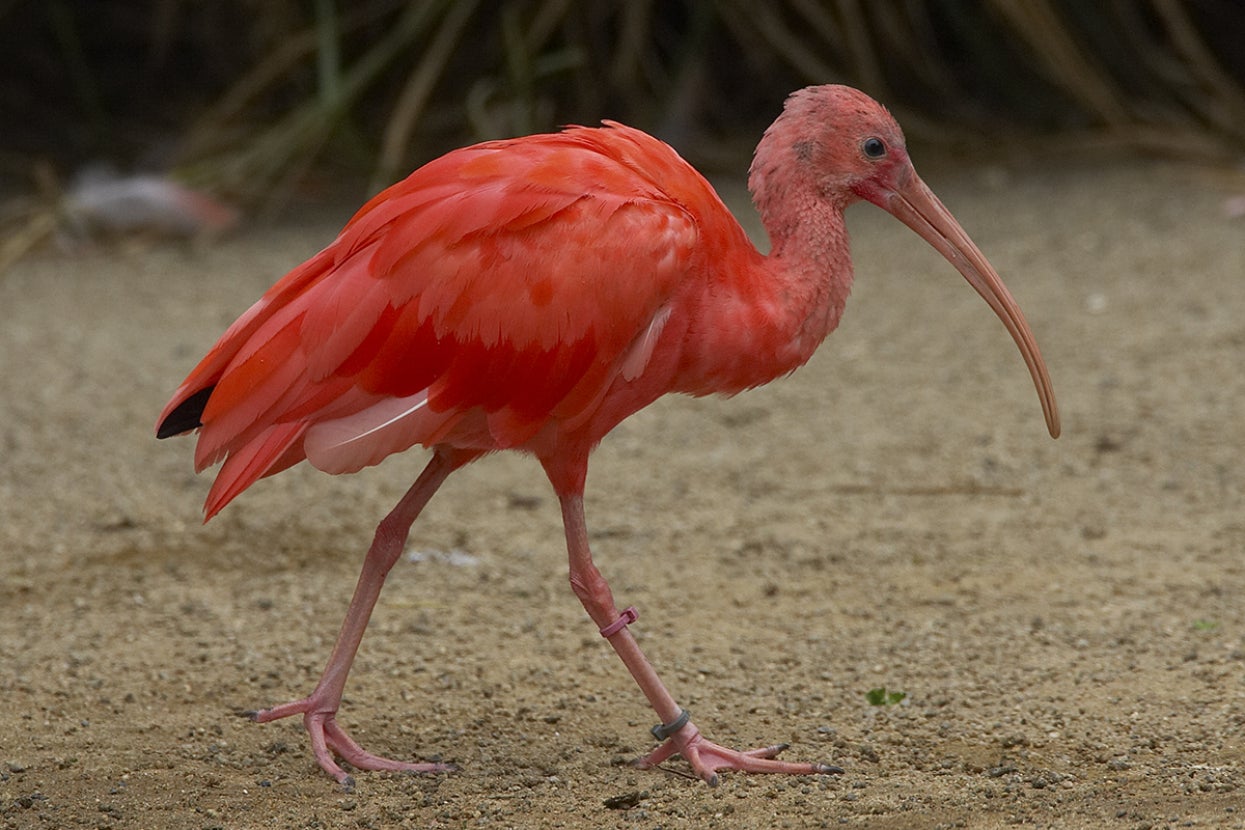
Scarlet ibises get their color from carotenoid pigments in their food.
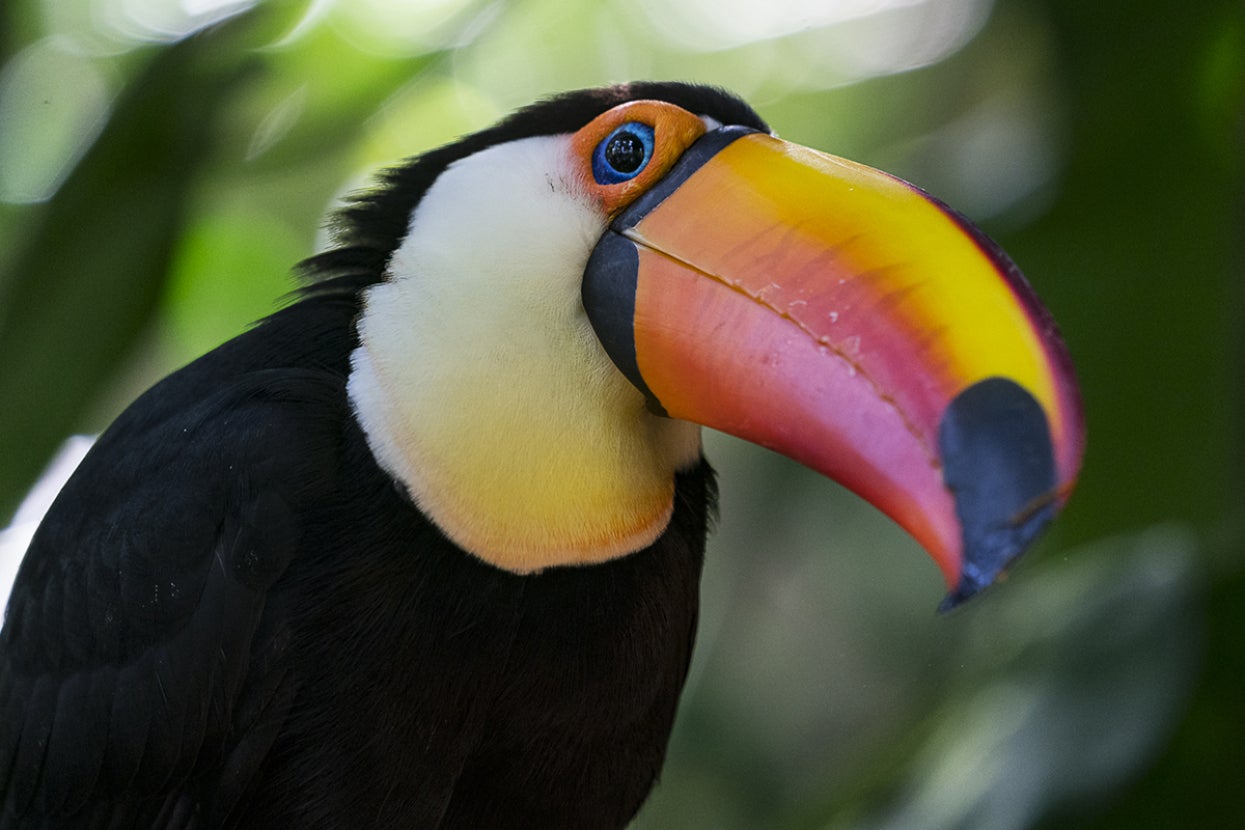
The toco toucan is the best-known member of the toucan family.
No matter your favorite color, you’ll find it in feather form at the San Diego Zoo and San Diego Zoo Safari Park. Wing on over! Not only will you experience some amazing avian wonders, but you’ll also support our conservation efforts on behalf of these and other species and the habitats in which they live.